Past - Development in the 5 expertise areas
Business & Entrepreneurship
I see Business & Entrepreneurship as a broader and more practical context in which design operates. Integrating a product or service into society requires considering multiple stakeholders and understanding how sustainable value can be created for both users and society (U&S). For me, sustainability is essential within Business & Entrepreneurship, as meaningful impact emerges from combining economic, social, and environmental value.
During Introduction to Technology Entrepreneurship, I learned how to identify and evaluate entrepreneurial opportunities and design business models to support them. In Entrepreneurship in Action, I applied this knowledge by developing a business concept called Diabuddy, a playful tool to help children manage their diabetes. During these courses, I gained hands-on experience with tools to analyse the viability of our concepts, including PESTLE and SWOT analyses, market research, and customer journey mapping.
During the course Design Innovation Methods, I was able to step into the role of a consultant. I gained a deeper understanding of which theories and tools are most useful at different stages of the design process. I became familiar with understanding users’ needs, creating value propositions, and applying tools such as MVP experiments to test assumptions, and the Futures Cone to analyse multiple possible futures, distinguish between them, and identify potential opportunities or risks.
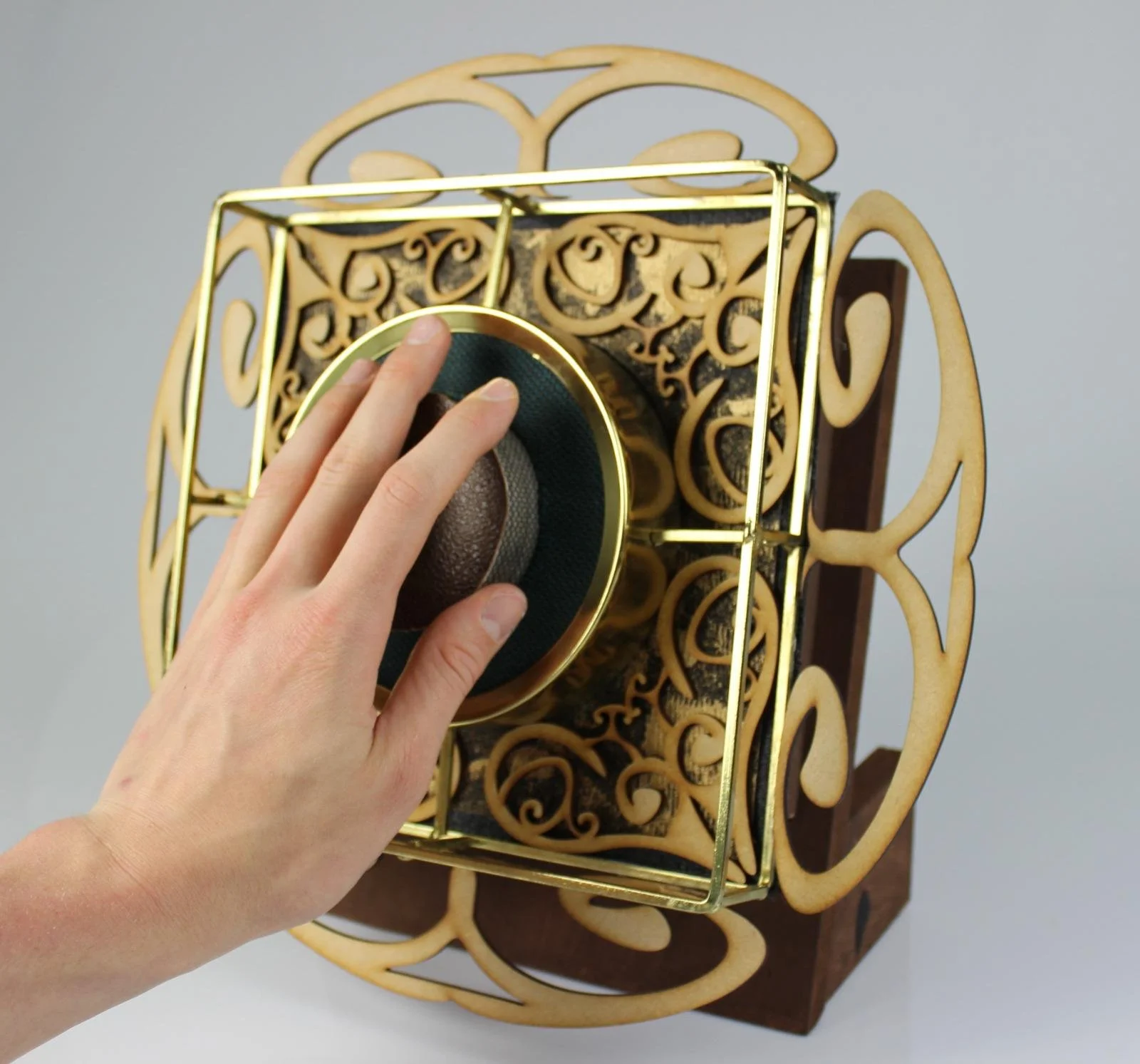
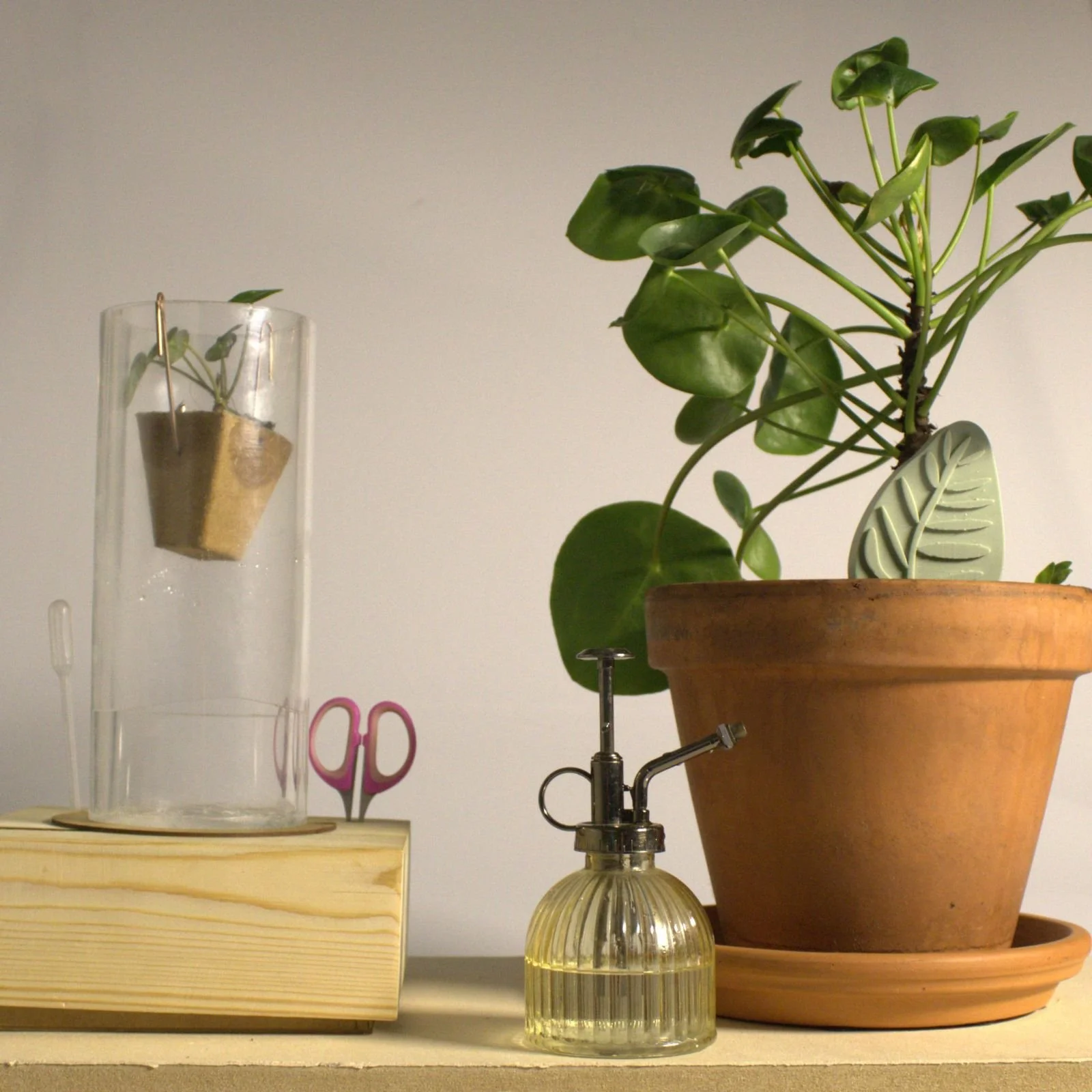
Project 2 prototype Stekkit
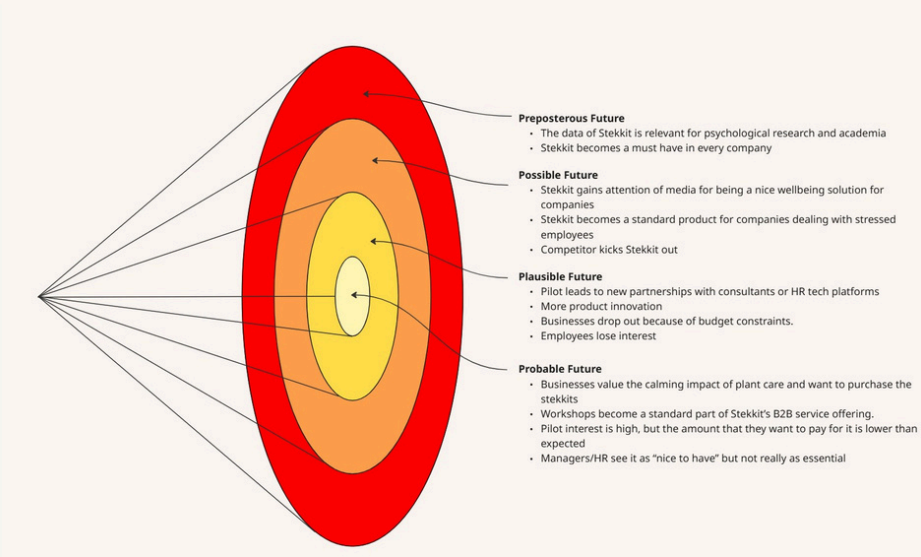
Analysing Stekkit through future cone
Voros, J. (2003). A generic foresight process framework. Foresight, 5(3), 10–21.
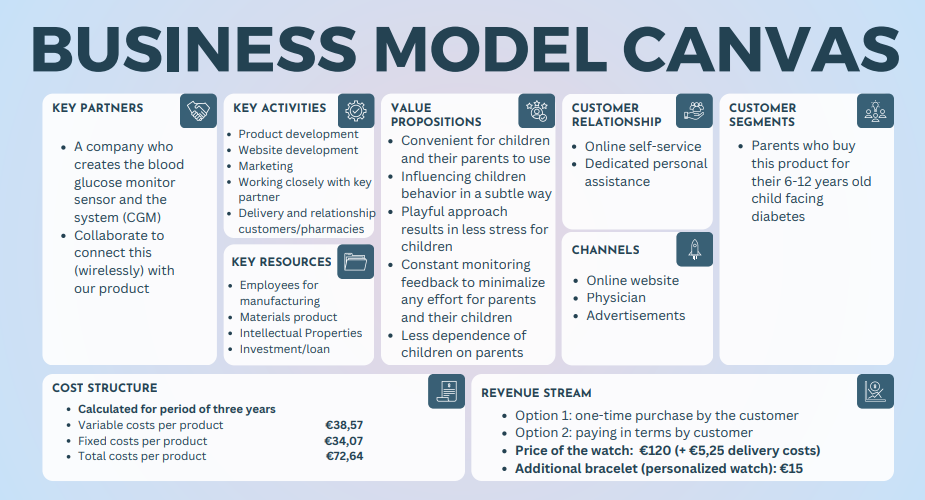
Business model canvas ‘'Diabuddy”
Osterwalder, A., & Pigneur, Y. (2010). Business model generation: A handbook for visionaries, game changers, and challengers. John Wiley & Sons.
Creativity & Aesthetics
Creativity and Aesthetics has become an important Expertise Area for me throughout my studies, as the aesthetics of your design often form a first impression. Over time, I have come to see creativity as the exploration of possibilities and ideas within the design process, while aesthetics reflect the quality of interactions and the visual expression of the design.
Project 1 and From Idea to Design introduced me to these creative processes, showing that creativity can be developed through different ideation techniques and design methods. I quickly realised that, for me, creativity means exploring through making and sketching. I improved my sketching skills during the course Exploratory Sketching, which I later applied in Games & Play, where I focused on the aesthetics and visual design of the game.
Aesthetics of Interaction was an important course for me when reflecting on my studies. This is where I learned how to combine my T&R skills with C&A. I focused particularly on exploring the aesthetics of haptics and tangibility. During AoI and exploratory Sketching, I learned to trust the design process itself, allowing ideas to evolve without starting from a clearly defined end goal.
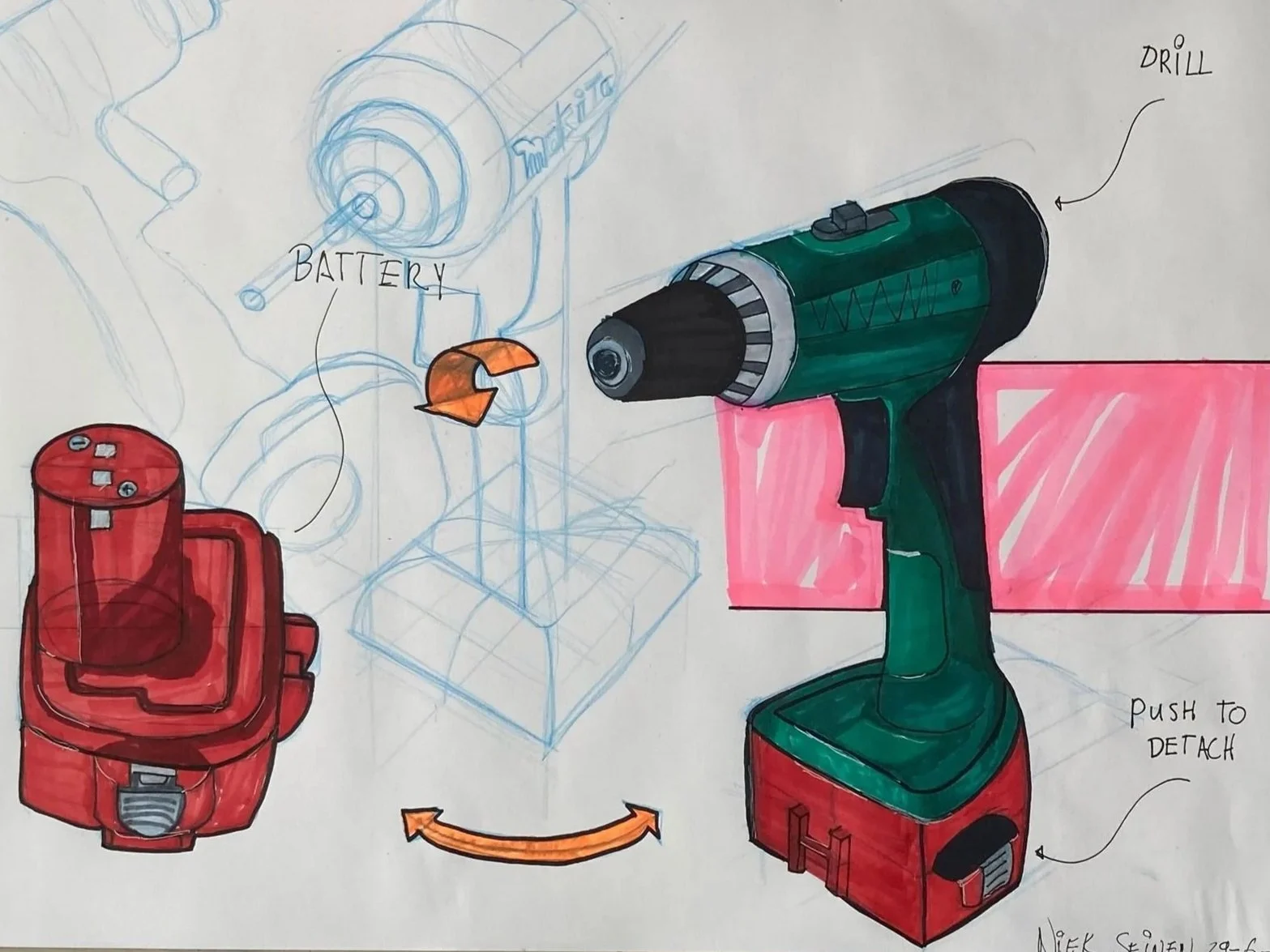
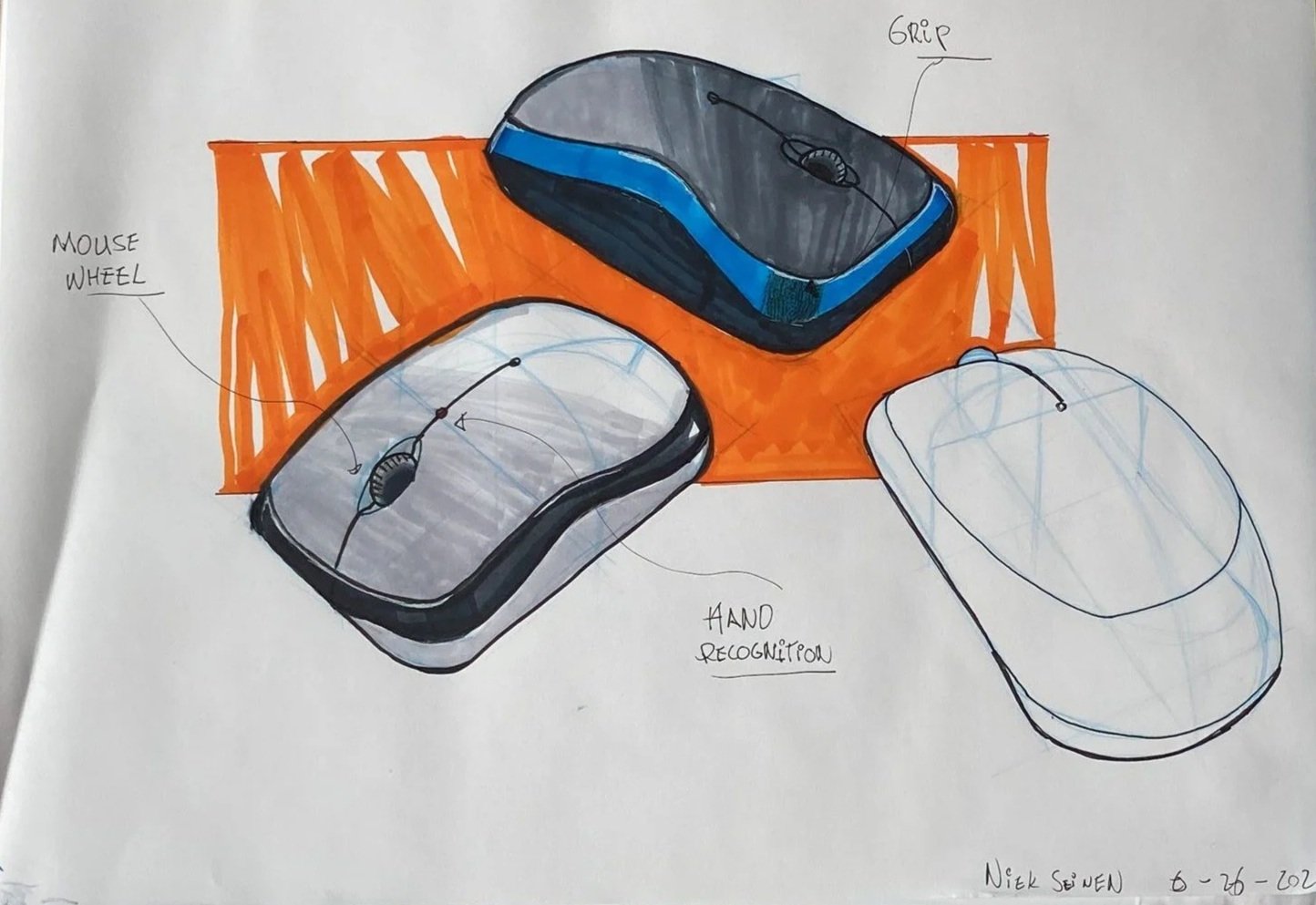
Aesthetics of haptic interaction
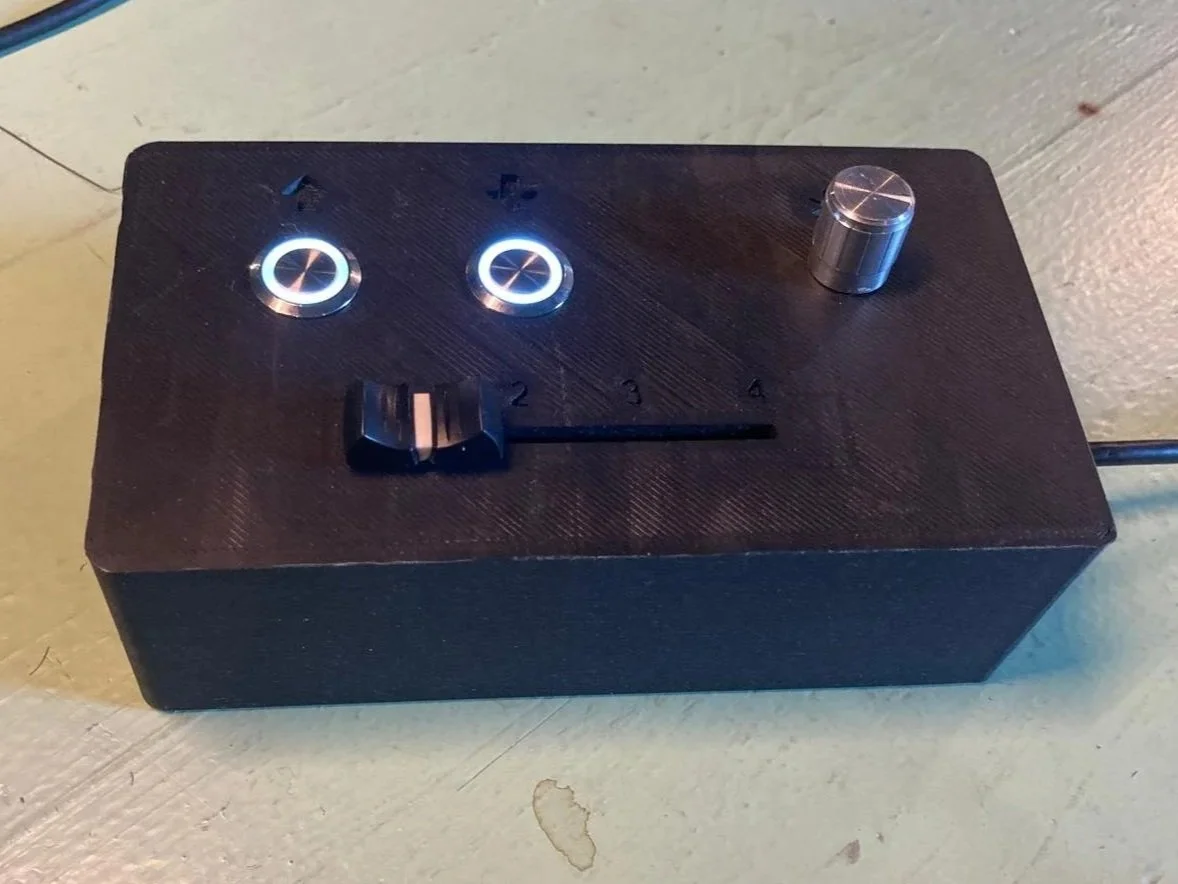
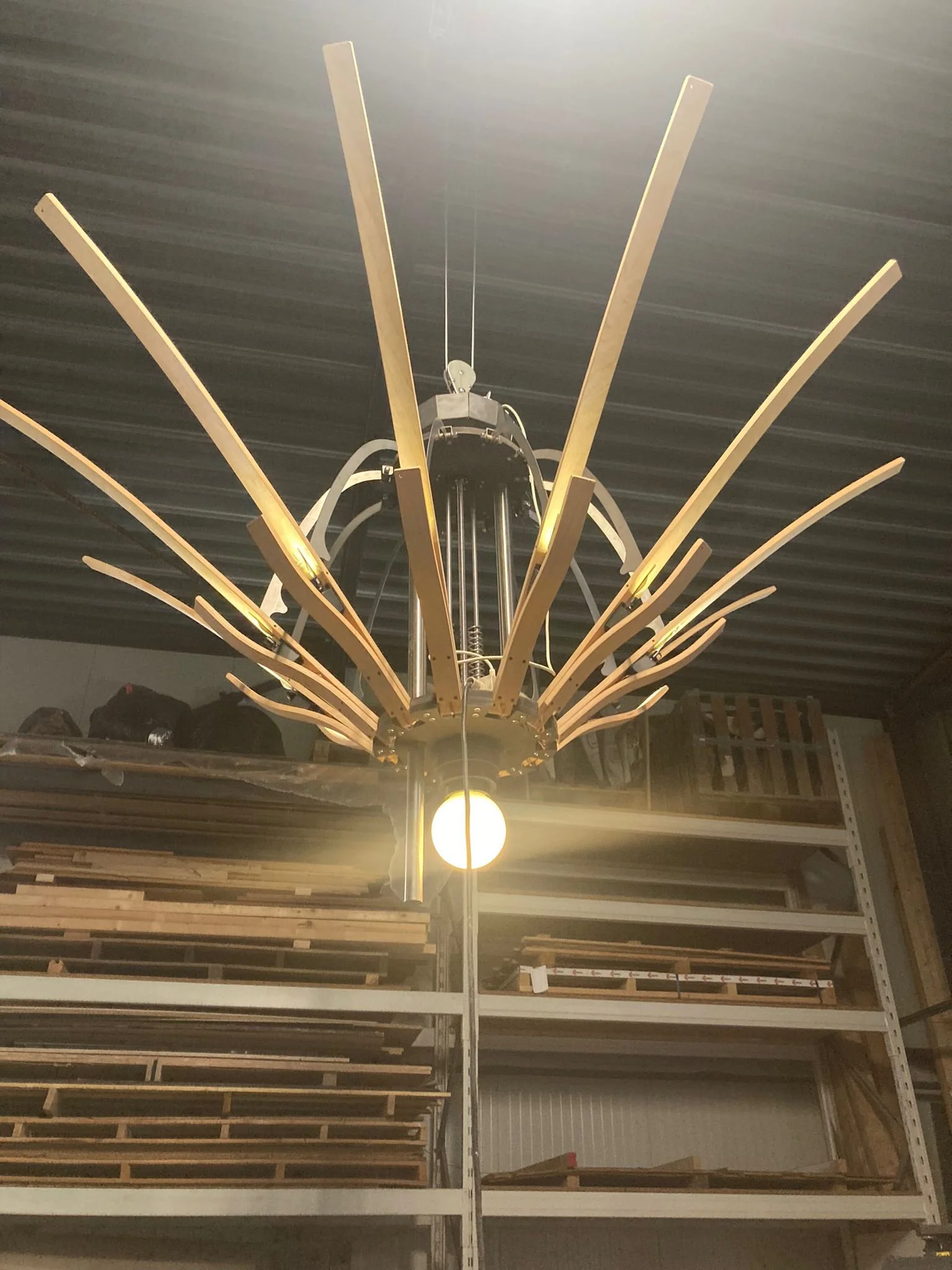
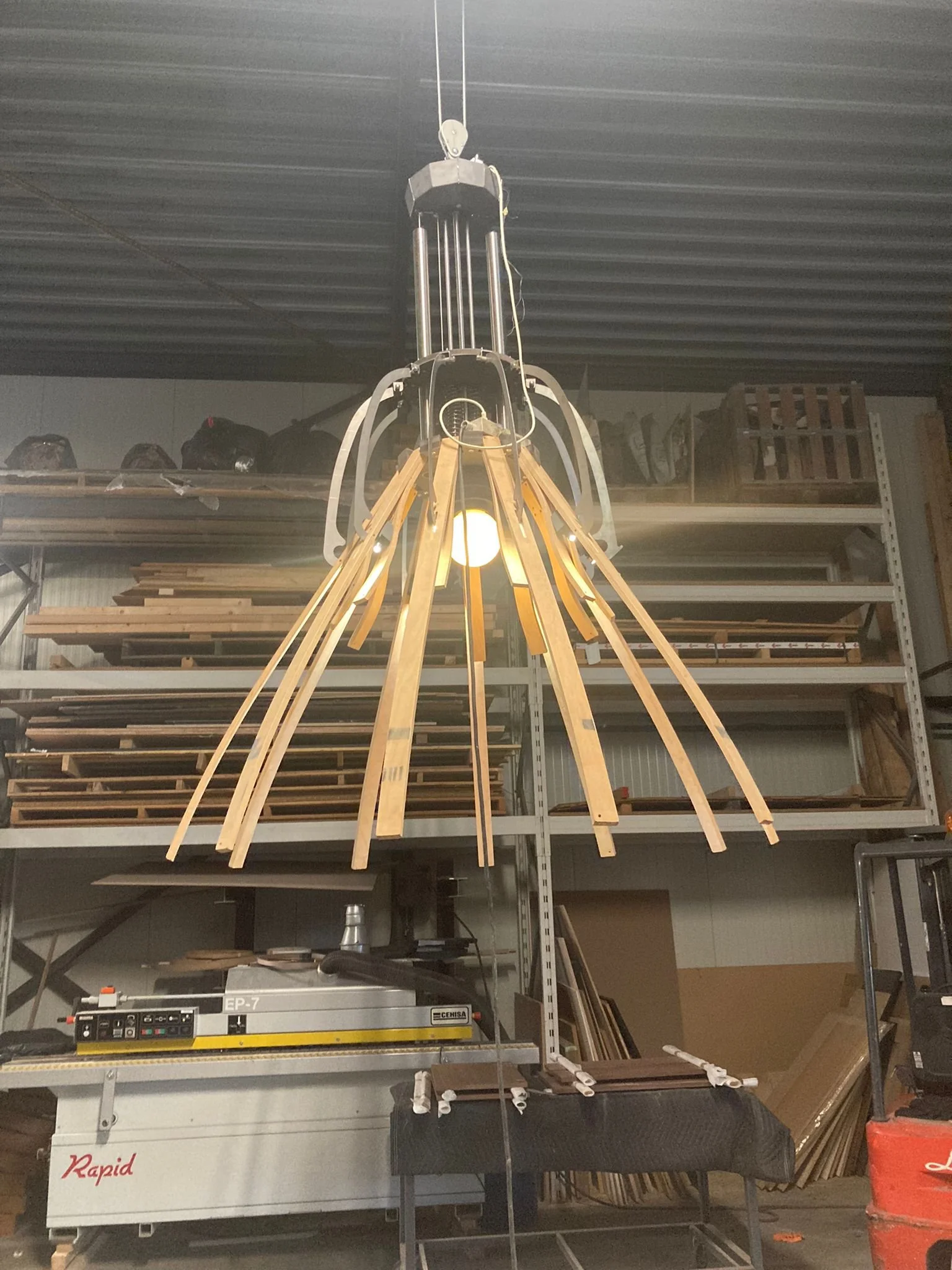
Wireless communication from tangible interface to lamp controlling the motion and lights
Math, Data & Computing
For me, this expertise area involves validating design decisions, analysing user tests or using data as inspiration to further develop concepts and uncover new opportunities.
I developed a foundation in programming through the courses Creative Programming and Creative Electronics, where I learned to work with both Arduino and Processing. Additionally, during Data Analytics, I gained a basic understanding of computing and working with larger datasets, while Making Sense of Sensors provided more hands-on experience with collecting, computing, and analysing my own data. During Project 3, I specifically focused on making sense of both quantitative and qualitative data to be able to analyse the research properly.
Beyond data analysis, programming significantly supported the improvement of my prototypes by combining my T&R skills with MDC. This programming foundation proved valuable in developing higher-fidelity prototypes, allowing me to better explore interaction and be able to communicate between different objects. In Project 2, I learned to work with OOCSI to create Wizard-of-Oz setups that convincingly simulate the desired interaction. I later applied this knowledge during my internship and in the Design Actuated Systems course, where I was able to translate the data from a tangible interface into motion and brightness related to angle wirelessly.
Technology & Realization
Technology and realization is the expertise area in which I have grown the most. The skills I have developed in this area allow me to constantly be able to realise and validate my own ideas. At the same time, I take a lot of inspiration from technology on how it can shape and inform my designs.
While I was still a bit scared to dive deeply into this area during my first year, I experienced significant growth during Project 2 and AoI. During P2, my main focus was on making a prototype both waterproof and fully functional electronically, by becoming more familiar with 3D printing, coding and circuitry building. During AoI, I used 3D printing more as an exploratory technique, ultimately enabling me to create a haptic device.
During my internship, I further developed these skills by working on a remotely controllable large mechanical lamp, through which I gained extensive experience in woodworking, welding, 3D modelling, coding, and circuit design. I was later able to integrate this knowledge in the Design Actuated Systems course, where I learned to perform digital motion analysis and gained in-depth insight into combining different techniques to create robust and reliable designs.
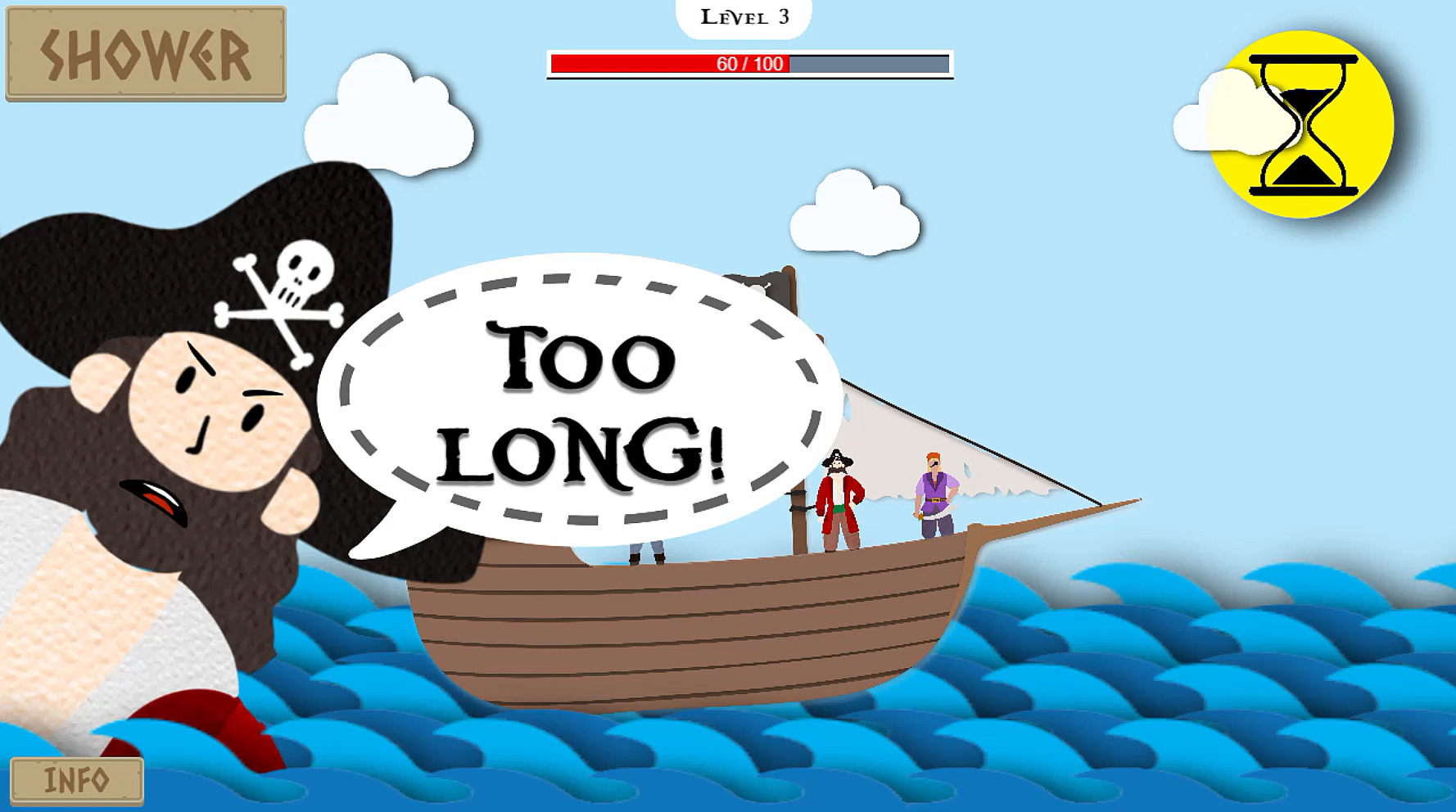
Researching feedback on the shower behaviour of users through a digital interface
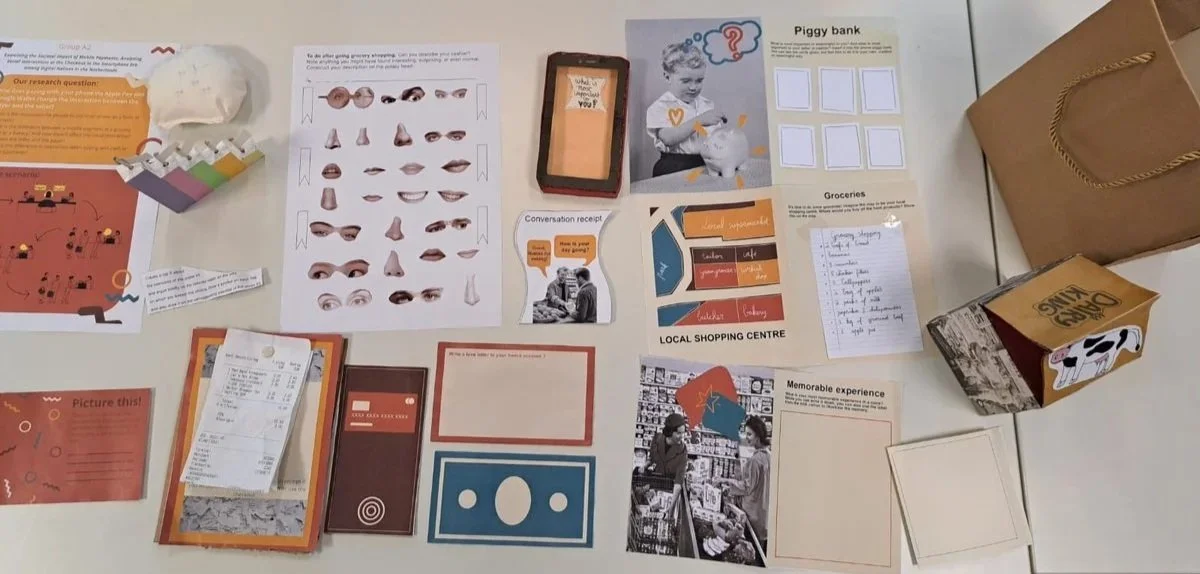
Understanding users through probes
User & Society
Throughout my studies, I’ve learned that design choices can influence user behavior, experience, and society. For me, considering users and society also means continuously engaging with people, gathering feedback, and integrating multiple perspectives to better understand the context I am designing for.
In the User-Centered Design course, I explored research and design methods such as semi-structured interviews, storyboards, and personas, alongside foundational user experience theory. This helped me appreciate how design can shape cognitive processes and guide user interactions.
I applied these methods in Project 1 by conducting semi-structured interviews to gather user insights. In Project 2, I expanded this approach by exploring multiple personas in the context of a smart home scenario set in 2040. Later, through Project 3 and the Design Research course, I focused on improving my research practice, becoming more aware of my own biases, and understanding how testing conditions and design choices can directly affect user experience and interaction. During my development in my studies, I recognised that my instinct to make quick decisions could sometimes lead to tunnel vision. As a result, I focused on actively presenting my work and seeking input from others to break out of tunnel vision, gain new perspectives, and continue exploring and creating. This not only strengthened my research and design process but also turned decision-making into one of my key strengths.